When a drainage problem occurs at a commercial property, one of the first questions may not be how to fix it, but who is responsible for dealing with it.
For a standalone business occupying its own premises, the answer may be relatively straightforward. However, commercial properties can involve landlords, tenants, managing agents, facilities teams, neighbouring businesses and shared drainage systems.
A blockage or damaged pipe can also occur some distance away from where the symptoms first appear. Understanding where the problem originates is therefore an important first step before deciding who needs to take action.
Why Commercial Drainage Responsibility Can Be Complicated
The drainage serving a commercial property does not necessarily stop at the boundary of an individual business.
A site may contain:
- Private drainage serving one premises
- Drainage shared between several units
- Landlord-maintained communal areas
- Surface water drainage
- Connections to the public sewer network
- Drainage passing beneath car parks, access roads or neighbouring areas
This means that discovering a blocked toilet or overflowing drain does not necessarily tell you who is responsible. The source of the problem may be located elsewhere within the drainage network.
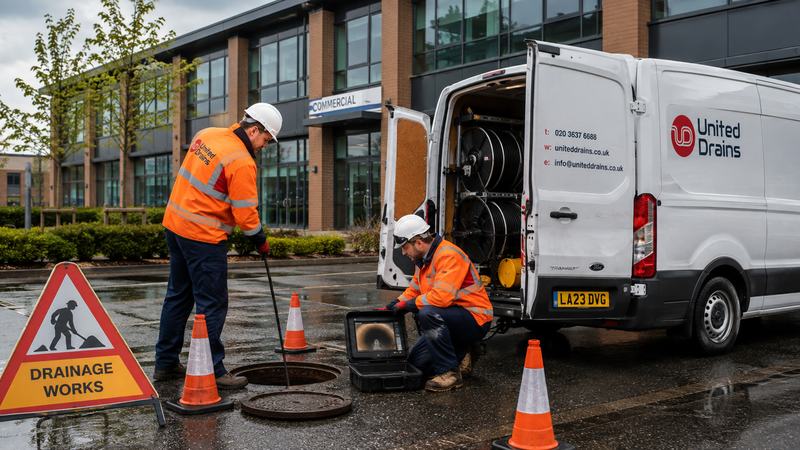
Where the cause is unclear, a professional CCTV drain survey can help establish what is happening underground and identify the location of blockages, damaged pipework or other defects.
Private Drains and Public Sewers
An important distinction is whether the affected section forms part of the property’s private drainage or the public sewer network.
Businesses will generally need to arrange maintenance and repairs to private drainage for which they are responsible, while problems affecting the public sewer network may need to be reported to the relevant water and sewerage company.
The difficulty is that it is not always immediately apparent where one ends and the other begins.
If several drainage points are affected, neighbouring premises are experiencing similar problems or the issue appears to be further along the network, further investigation may be necessary before responsibility can be established.
Landlord or Commercial Tenant?
For rented commercial premises, responsibility can depend on the terms of the lease.
Different agreements may allocate responsibility for repairs, maintenance and shared services differently. A tenant may have responsibility for maintaining drainage serving their individual unit, while a landlord or managing agent may manage drainage serving communal areas.
This can become particularly important on larger commercial developments where several businesses share infrastructure.
If you are unsure, check the property’s lease or maintenance agreement and speak to the landlord, managing agent or facilities team before arranging major repair work.
What About Multi-Occupancy Commercial Sites?
Retail parks, industrial estates, office developments and other multi-occupancy properties can make identifying drainage responsibility considerably more challenging.
Imagine three businesses occupying neighbouring units. Only one experiences a toilet backing up, but the actual obstruction is located further downstream in a section of drainage shared by all three businesses.
What initially appears to be a problem within one unit could therefore involve shared infrastructure.
This is one reason why determining the location and cause of a drainage problem can be just as important as clearing it.
Finding the Source of the Problem
When the origin of an issue is not obvious, a professional drainage investigation can help build a much clearer picture.
The first stage may involve checking accessible drainage points and establishing which parts of the system are affected. Depending on the circumstances, further investigation can then be carried out to understand what is happening underground.
A CCTV drainage inspection allows engineers to view the internal condition of pipework without immediately resorting to excavation.
It may help identify:
- Obstructions
- Damaged pipework
- Displaced joints
- Root ingress
- Cracks or structural defects
- Build-up within the pipe
- The approximate location of the drainage problem
This information can be particularly valuable when several parties are involved because it provides evidence about where an issue is occurring rather than relying solely on where the symptoms first appeared.
What If the Pipework Is Damaged?
Once the location of a problem has been identified, the appropriate repair will depend on the condition of the drainage system.
Some issues may be resolved through cleaning or clearance, while damaged or collapsed pipework may require more extensive work.
Where excavation is necessary, professional drain excavation and repair services can be used to access damaged sections of underground pipework and carry out the necessary repairs.
Accurate investigation before excavation can help reduce unnecessary digging and ensure work is focused on the correct area of the site.
Keep Records of Your Commercial Drainage System
One simple step commercial property managers can take is to maintain good drainage records.
Where available, keep drainage plans alongside records of previous inspections, maintenance and repairs.
If the same area repeatedly experiences problems, previous information can help engineers understand the history of the system and identify recurring patterns.
Records can also be useful when responsibility is shared between landlords, tenants or managing agents.
For larger commercial sites, understanding where important manholes, gullies, interceptors and drainage runs are located can make future maintenance and investigation considerably easier.
Planned Maintenance Can Help Avoid Disputes
Where drainage infrastructure is shared between several parties, planned maintenance can help reduce the likelihood of problems developing unnoticed.
Including drainage within a wider Planned Preventative Maintenance programme allows commercial sites to inspect and maintain key drainage assets at appropriate intervals rather than waiting until an emergency occurs.
This can be especially valuable for landlords, managing agents and facilities teams responsible for larger commercial developments.
Regular maintenance can also provide a clearer history of the condition of the drainage system, which may prove useful if responsibility for a future problem needs to be established.
Do Not Ignore a Problem While Responsibility Is Being Established
When several organisations could potentially be responsible, it can be tempting to wait until somebody establishes whose problem it is.
Unfortunately, the drainage issue may continue to develop in the meantime.
If wastewater is backing up, flooding is occurring or the problem could affect the safe operation of a commercial property, investigating it promptly can help limit further disruption and potential damage.
The findings can then help landlords, tenants, managing agents or other responsible parties determine the appropriate next steps.
What Should You Do When a Drainage Problem Appears?
If you are responsible for a commercial property and discover a drainage issue, taking a methodical approach can make it easier to establish both the cause and responsibility.
- Identify which toilets, sinks, gullies or other drainage points are affected.
- Check whether the problem is isolated or affecting several areas.
- Ask neighbouring occupants whether they are experiencing similar issues where appropriate.
- Check any available drainage plans.
- Review the relevant lease or maintenance agreement if the property is rented.
- Record photographs or other evidence of the problem.
- Arrange professional investigation where the source is unclear.
- Contact the relevant water company if evidence suggests the problem lies within the public sewer network.
The sooner the source of the problem is identified, the easier it is to determine what needs to happen next.
Why Recurring Drainage Problems Should Be Investigated
Repeatedly clearing the same blockage without establishing why it keeps returning can result in unnecessary cost and disruption.
Recurring problems may indicate:
- Damaged pipework
- Root intrusion
- Incorrect falls within the drainage system
- Restricted or partially collapsed pipework
- Repeated build-up within the same section
- Problems further downstream within shared drainage
In these situations, further investigation can help determine whether the problem belongs to one property or forms part of a wider issue affecting the site.
Commercial Drainage Support from United Drains
Drainage systems can be complex, particularly across large or multi-occupancy commercial sites.
United Drains works with businesses, landlords, managing agents and commercial property teams to investigate drainage problems, identify faults and provide appropriate drainage solutions.
Whether you are dealing with a blockage, recurring drainage issue, damaged pipework or simply need a clearer understanding of what is happening below ground, our experienced engineers can assess the situation and recommend the appropriate next steps.
Identifying where the problem actually lies can save time, reduce unnecessary work and help everyone involved understand what needs to happen next.
If something is not right with the drainage at your commercial property, contact the United Drains team to discuss the issue and arrange an appropriate investigation.